
Nikro Air Duct Cleaning in Clovis: A Homeowner’s Guide
Nikro air duct cleaning in Clovis means a HEPA-filtered negative-pressure vacuum system is pulling air through your ducts while agitation tools physically dislodge debris from the duct walls. It’s the same extraction principle remediation crews use after fires and mold events, adapted for residential systems. If you’d rather not sort through equipment specs, call (855) 661-0630 and we’ll walk you through what your ducts actually need.
Here’s the uncomfortable truth we’ve learned from years of opening up duct systems across Clovis: a lot of “professional” duct cleaning never touches most of the duct surface. A shop vac connected to a register can’t generate enough airflow to pull debris from 40 feet away. It makes noise. It fills a small canister. The homeowner sees something in the bag and assumes the system is clean. It isn’t.
Nikro equipment solves that problem with raw physics. And once you understand the mechanics, you’ll know exactly what questions to ask any contractor before they step foot in your home.
What a Nikro System Actually Does Inside Your Ducts
Nikro manufactures negative-pressure air scrubbing and HEPA filtration systems. The core principle is simple: instead of pushing air and debris around with a brush and hoping it lands somewhere useful, Nikro equipment pulls air toward a single collection point with enough force that debris can’t escape.
Think of it like this. If you sweep a dusty floor with a broom, you move dust into a pile. Some of it becomes airborne. Some drifts into corners. If you instead place a powerful vacuum behind the broom as you sweep, the airborne dust gets captured before it settles elsewhere. That’s the distinction between agitation alone and agitation paired with true negative pressure.
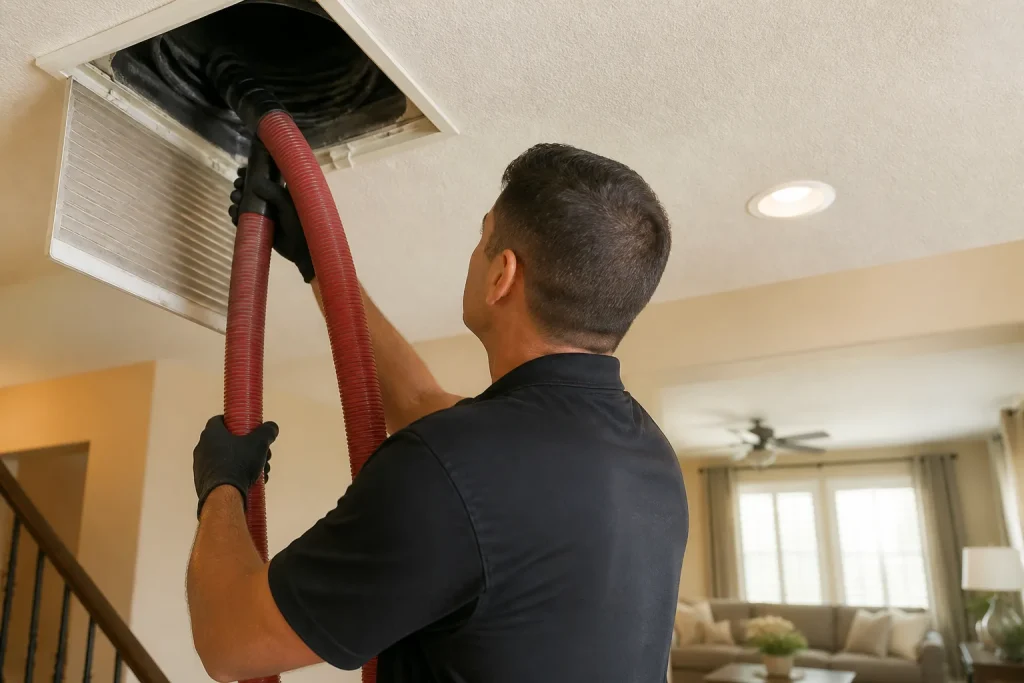
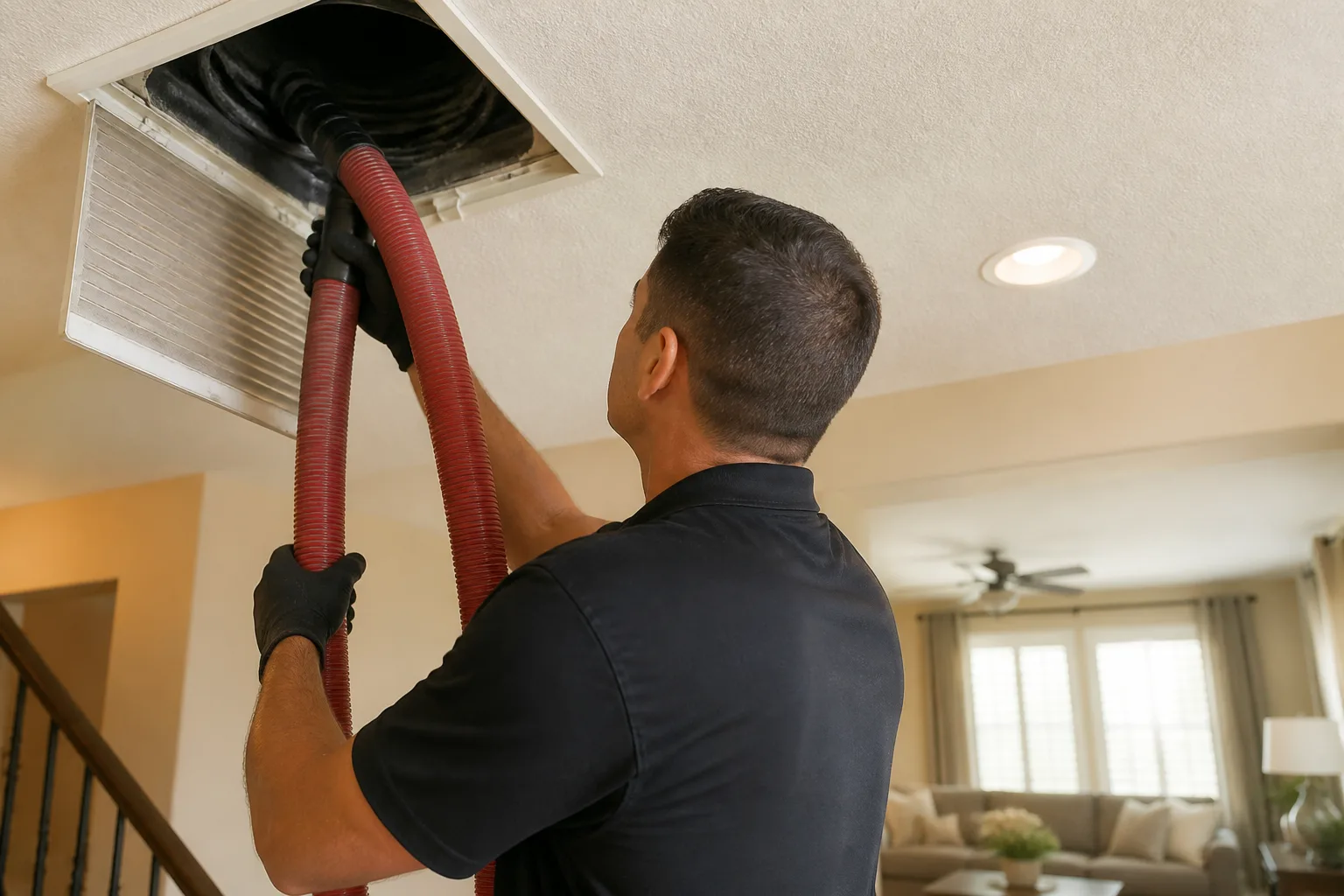
In a duct system, a Nikro negative-pressure unit typically connects to the main trunk line and pulls air through the entire system at high airflow, while access points are sealed to maintain that vacuum. Meanwhile, agitation tools like the Rotobrush system we use for air duct cleaning in Clovis physically scrub the duct walls. The brush knocks debris loose. The Nikro unit ensures that debris travels in one direction: toward the HEPA-filtered collection point, not back into your living room.
Most consumer-grade setups skip this entirely. They rely on a brush or a compressed-air wand to loosen debris, with a low-power vacuum that captures whatever happens to drift close. That’s not extraction. That’s disturbance.
Why HEPA Filtration Matters in Clovis Specifically
Clovis sits in the San Joaquin Valley, which has some of the most challenging particulate air in California. Agricultural dust from surrounding farmland, PM2.5 and PM10 from vehicle traffic on Highway 168, and seasonal wildfire smoke from Sierra foothill fires all find their way into duct systems. Once inside, they settle and accumulate.
A standard vacuum filter captures larger debris, but lets fine particulates pass straight through and back into your home’s air. Nikro systems use HEPA filtration rated to capture 99.97% of particles at 0.3 microns. That’s the size range where Valley smoke particulates and fine agricultural dust live.
Here’s what that means in practical terms. If we’re cleaning ducts in a Clovis home that’s been through a heavy wildfire smoke season, a non-HEPA system would pull smoke particulates out of the ducts and redistribute them through the exhaust. You’d finish the job with dirtier indoor air than you started with. A Nikro HEPA system traps those particulates at the collection point. They leave the house in a sealed canister, not through a vent.
This is also why we incorporate Abatement Technologies equipment in our Duct Cleaning Clovis home service area for contamination-heavy jobs. That equipment line is built for remediation work, where the standard isn’t “cleaner than before” but “actually removed from the environment.”
The Two-Step Sequence: Why Nikro and Rotobrush Need Each Other
We occasionally run into homeowners who’ve been told a negative-pressure system alone is sufficient. It isn’t. And the reverse is also true: a brush alone just stirs things up.
Here’s the sequence as it should work:
- System setup and sealing. The Nikro negative-pressure unit connects to the main trunk line. Access points are opened and sealed strategically so air flows in one controlled direction.
- Mechanical agitation. A Rotobrush or similar agitation tool enters each duct run, physically scrubbing the walls to break loose caked-on debris, dust, and biological growth.
- Continuous extraction. As debris is loosened, the negative pressure pulls it downstream to the Nikro collection point. Nothing lingers. Nothing drifts.
- HEPA filtration. Debris passes through the HEPA filter, capturing fine particulates before air is exhausted safely.
Skip step 2 and you have a vacuum that can’t dislodge anything stuck to the duct walls. Skip step 3 and you have a brush throwing dust through the registers and back into the home. Both tools earn their place only when they work together.
We pulled a duct run out of a home near Dry Creek Trail last month where the previous “cleaning” had been brush-only. The bottom third of the duct was still coated in a hardened dust crust. The homeowner had paid for a service that never physically removed what was stuck.
How to Verify Nikro Equipment Was Actually Used
A contractor can say anything. Here’s what you can check with your own eyes before paying the invoice.
Ask to see the equipment. A Nikro negative-pressure unit is not subtle. It’s a wheeled or portable industrial machine with a large collection canister and visible HEPA filter housing. If the crew arrives with a small shop vac and a brush, that’s your answer.
Check the collection canister. At the end of the job, the canister should contain the debris removed from your ducts. For a genuinely dirty system, that’s often a significant volume: dust, pet hair, construction debris, dead insects, and sometimes toys. If the canister is suspiciously empty after a “full system cleaning,” the debris is probably still in your ducts.
Ask about HEPA filter condition. HEPA filters have a finite service life. A company using HEPA filtration should be able to tell you when their filters were replaced and show you the filter housing. If they can’t answer that question, they may not actually be running HEPA filtration.
Feel for negative pressure at registers. During the cleaning, a negative-pressure system will pull air in through open access points and registers. Hold a tissue near a register and you should see it drawn toward the duct. No pull means no negative pressure, regardless of what the invoice says.
For homes with whole-home filtration systems like Aprilaire or Honeywell, you’ll also want to confirm the duct cleaning crew understands how those systems integrate with your ductwork. A proper cleaning considers the connection points, the filter media, and the airflow balance. Cleaning ducts as if the filtration system doesn’t exist leaves half the air path untreated.
When Nikro-Level Cleaning Is Mandatory vs. Optional
Not every duct system requires HEPA-grade negative-pressure extraction. But some situations leave no room for compromise.
Mandatory: Mold or Microbial Growth
If there’s visible mold inside duct runs or a persistent musty odor that doesn’t resolve with filter changes, you need extraction equipment that won’t redistribute spores. HEPA filtration is non-negotiable here. Brush-and-vacuum approaches with standard filters will spread contamination rather than remove it.
Mandatory: Post-Construction or Renovation Cleanout
Drywall dust, sawdust, and construction debris in a newly renovated Clovis home require serious extraction. These materials are heavy and settle deep into duct runs. Standard vacuums clog or simply can’t pull enough volume. A negative-pressure system with a large-capacity collection canister is the only way to get it all out.
Mandatory: Smoke-Damaged or Wildfire-Exposed Ducts
After a Valley fire event or even heavy seasonal smoke exposure, duct systems trap fine smoke particulates. HEPA filtration ensures those particulates are captured rather than recirculated. This is a real, observable difference in Clovis homes during smoke season.
Optional: Routine Maintenance Cleaning
For a standard maintenance cleaning on a system that’s been cleaned within the past three to five years, professional-grade negative pressure is still the better approach, but the stakes are lower. However, we’re in Clovis. Agricultural dust and seasonal smoke mean “standard” conditions are heavier than what homeowners in other parts of California deal with. We recommend professional-grade equipment on every job because the baseline particulate load here justifies it.
What This Means for Your Clovis Home
If you’re paying for duct cleaning, you should know what you’re actually paying for. Nikro HEPA-filtered negative-pressure extraction is a specific, verifiable standard. It’s not marketing language. It’s equipment you can see, feel, and measure.
Here’s what to remember:
- Negative pressure means debris moves toward the collection point, not into your home. This is the core difference between extraction and disturbance.
- HEPA filtration captures the fine particulates that matter in the San Joaquin Valley. Standard filters let wildfire smoke and agricultural dust pass through.
- Agitation and extraction must work together. A brush without negative pressure spreads debris. Negative pressure without agitation leaves stuck-on debris in place.
- You can verify the work. Collection canister volume, HEPA filter condition, and register airflow are all checkable before you pay.
When to call a pro: if you see visible dust or debris at registers, if you smell musty air when the system runs, if your energy bills climb without explanation, or if anyone in your home is dealing with unexplained respiratory irritation, it’s time. If there’s visible mold or you’ve had a recent renovation, don’t wait. The longer debris sits, the harder it is to remove.
Related services in Clovis: Dryer Vent Cleaning in Clovis addresses lint buildup, which is among the leading causes of residential dryer fires. Air Duct Repair in Clovis handles damaged, disconnected, or leaking duct runs that cleaning alone can’t fix.
The Bottom Line
Nikro isn’t a buzzword. It’s a mechanical standard for what duct cleaning should be: negative-pressure airflow paired with HEPA filtration so debris leaves your home instead of resettling inside it. In Clovis, where agricultural dust and wildfire smoke make fine particulates a year-round reality, that standard matters more than it does almost anywhere else in the state. You can check whether your contractor actually used this equipment. You should check. The difference shows up in the collection canister, in the filter housing, and in the air you breathe after the job is done.
If you’re in Clovis and want a duct cleaning that actually removes what’s in your system, Duct Cleaning Clovis offers free estimates. Call (855) 661-0630 and we’ll tell you honestly whether your ducts need work, and what kind.
Frequently Asked Questions
Nikro systems generate true negative pressure with HEPA filtration, pulling air through the entire duct system at high volume while brushes agitate the duct walls. A standard shop vac or basic truck-mount system lacks both the airflow volume and the filtration to capture fine particulates, meaning debris gets disturbed but not fully removed. The difference is measurable in what ends up in the collection canister.
Ask to see the equipment before work begins. A Nikro unit is a visible industrial machine with a collection canister and HEPA filter housing. During the job, you should feel air pulling in at open registers. After the job, the canister should contain a visible volume of debris. If any of these checks fail, call (855) 661-0630 before paying and we’ll help you evaluate what was actually done.
For Clovis homes, yes. The San Joaquin Valley’s agricultural dust and seasonal wildfire smoke produce fine particulates that standard vacuums recirculate rather than capture. A cheaper cleaning that leaves fine debris in your ducts means you’ve paid for air movement, not air improvement. Homes with allergy sufferers, recent renovations, or smoke exposure should treat HEPA-grade extraction as a requirement, not an upgrade.
Nikro HEPA-filtered negative-pressure systems can safely remove mold-affected debris when paired with proper agitation and professional protocols. The critical factor is containment: HEPA filtration prevents spores from being redistributed through the home during cleaning. If you suspect mold in your Clovis duct system, don’t attempt DIY cleaning. Call (855) 661-0630 for an assessment.
Written by the team at Duct Cleaning Clovis, serving Clovis since 2012.
Need Air Duct Cleaning Help?
Call Duct Cleaning Clovis - licensed & insured, here with fast help in Clovis.
(855) 661-0630